
MathPlayzone: A Simple Guide to Online Math Games, Learning, and Safe Play
mathplayzone Finding a website that makes math more enjoyable can be a challenge, especially for students who find regular worksheets boring. Many children understand a math concept when someone explains it with examples, but they lose interest when they have to solve the same type of question again and again. This is where interactive math games can help.
MathPlayzone is a name that suggests a place where mathematics and play come together. For students, parents, and teachers, the idea is simple: make learning numbers, patterns, calculations, and problem-solving feel more like an activity than a chore.
However, before using any website with this name, it is important to check what it actually offers. Websites can change their content, features, and design over time. Rather than assuming that every feature is available, this guide explains how to approach MathPlayzone, what to look for, how math games can support learning, and how to make the experience useful for everyday study.
Whether you are a student looking for a more interesting way to practise arithmetic or a parent searching for educational activities at home, a little planning can help you get better results.
What Is MathPlayzone?
MathPlayzone can be understood as a name associated with math-based play and learning. The main idea behind a platform of this kind is to combine mathematical exercises with interactive activities that encourage users to practise their skills.
Instead of only reading a lesson or writing answers in a notebook, a learner may use number challenges, puzzles, timed questions, or other game-style activities. These formats can make practice feel less repetitive.
For example, a student who struggles with multiplication might spend ten minutes answering multiplication questions in a game. Another student who already knows basic multiplication may prefer number puzzles that require logical thinking.
The best activity depends on the learner’s age, current ability, and learning goals.
It is worth making one distinction clear: the name alone does not confirm the features, ownership, safety standards, or educational quality of a particular MathPlayzone website. If you have found a specific website, check its exact web address, available activities, privacy information, and terms before using it.
This is especially important when a site is unfamiliar or appears in search results alongside websites with similar names.
Why Math Games Can Make Learning Easier
Many students do not dislike mathematics itself. They dislike feeling confused, making mistakes in front of others, or repeating exercises without understanding why they matter.
Interactive games can help by giving learners a clear goal and immediate feedback. When an answer is wrong, a well-designed activity may let the student try again and work out the correct answer.
Consider a child learning addition. Solving 15 + 8 on a worksheet may feel like an ordinary task. In a number game, the same question might appear as part of a challenge to collect points or reach a target. The calculation has not changed, but the presentation may make the child more willing to practise.
There are several possible benefits.
More practice without as much boredom: Short challenges can encourage students to solve more questions than they might complete in a traditional exercise session.
Quick feedback: Students can discover mistakes while the question is still fresh in their minds.
Better number confidence: Repeated practice can help learners become more comfortable with basic calculations.
Logical thinking: Puzzles may encourage students to recognise patterns, compare possibilities, and work through problems step by step.
Independent learning: Children can sometimes practise familiar skills without needing an adult to explain every question.
These benefits are not automatic. A game that is too easy may provide little learning value, while a game that is too difficult can lead to frustration. The most useful activity offers a suitable challenge and encourages the student to understand the answer rather than simply tap buttons quickly.
Types of Activities to Look For on MathPlayzone
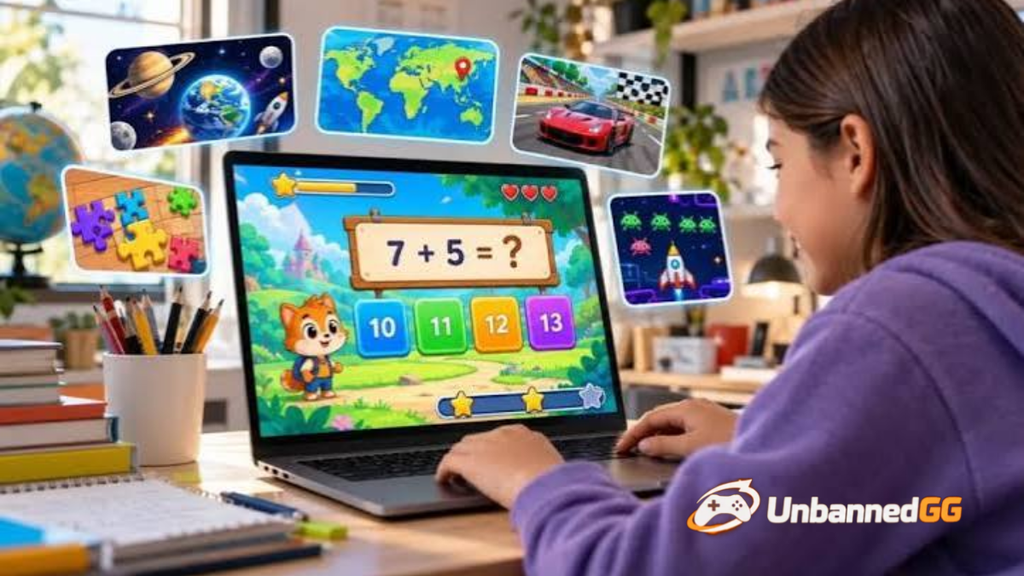
When exploring MathPlayzone or a similar educational platform, look for activities that match the skill you want to improve. The following examples describe useful types of math games; they should not be taken as confirmation that every category is available on the specific website.
1. Addition and subtraction challenges
These activities help beginners practise basic arithmetic. Questions can use small numbers at first and gradually introduce larger calculations.
For example, a student might solve 24 + 17. Instead of guessing, they can break the calculation into smaller steps:
- 24 + 10 = 34
- 34 + 7 = 41
This method helps build number sense and makes mental arithmetic easier.
2. Multiplication practice
Multiplication games can help students remember times tables and recognise repeated addition.
Suppose a question asks for 6 × 7. A learner who has forgotten the answer can think of six groups of seven or use a known fact, such as 5 × 7 plus another 7.
A useful game should help learners become more accurate over time. Speed can improve naturally after they understand the underlying calculation.
3. Number puzzles
Number puzzles are helpful for students who enjoy finding patterns and solving mysteries.
A puzzle might ask which number comes next in a sequence:
3, 6, 9, 12, __
The missing number is 15 because each step adds three.
More advanced puzzles can introduce fractions, negative numbers, or other mathematical ideas. They encourage students to explain how they reached an answer, not just identify the answer itself.
4. Fractions and decimals
Fractions often become difficult when students move beyond whole numbers. Visual activities can make the concepts easier to understand.
For example, a picture divided into four equal parts can show why two shaded parts represent 2/4, which is equivalent to 1/2.
Decimal activities can also connect mathematics with familiar situations, such as money, measurements, and prices.
5. Timed mathematics challenges
Timed games may help learners improve fluency once they understand the material. However, speed should not become the only goal.
If a child regularly answers incorrectly because the timer creates pressure, start with untimed questions. Build accuracy first, then introduce short timed rounds if they are comfortable with the format.
A good learning routine rewards understanding, not just fast clicking.
Also Read: unbannedgg